



The K’Mayim Challenge

The K’mayim Sefira Challenge is a 4-week journey designed for teachers across all grades.

Each week, you’ll take on one focused, practical challenge—small, intentional shifts that reshape how you think about, relate to, and respond to your students.

This is not about adding more to your workload. It’s about infusing what you’re already doing with deeper awareness and purpose.

Are You Ready to Begin?

Over the coming weeks, you’ll be guided step by step through this process. No complicated systems.

Just internal work that leads to real results.


  1. Choose your students
  2. The Foundation
  3. What this looks like

1. Choose your Students

Choose 2-4 students who you feel you did not connect with/get through to yet who will become YOUR Kmayim students, and watch the ripple effect take place.


Is it the quiet one who is never seen? 

Do you really know her? Her likes, her challenges, her dreams she wishes will come true? Did you hear her voice yet? 


Is it the student with the Personality Clash?

She rubbed you the wrong way. Too outspoken. Too quick. She’s just all over the place!


Is it the student who is not in a good place b’ruchnius?

Emotionally insecure. Unsettled. Possibly because of personal challenges either at home or within herself.

Did you have a specific incident with a student that left a gaping hole?

Does she feel misunderstood? Does she harbor negative feelings towards you?

2. The Foundation

Understand the kamayim principals and their practical application within a classroom setting.

כמים הפנים אל פנים כן לב האדם לאדם

משלי כז:יט

Just as a face is reflected in water, so too one heart reflects another.

Rashi, in his explanation on the Gemara in יבמות, teaches:

If a rebbi interacts pleasantly with a student, he will be successful.

An emotional connection with a student is not a “nice extra.”

It is one of the most powerful drivers of her success.

We plan our lessons carefully.

But do we invest the same thought and energy into the relationship?

Because the reality is:

A strong, healthy teacher-student connection is the key to success.


The K’mayim Principles:

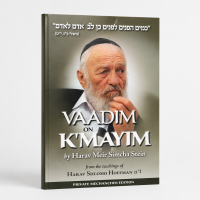
From the book Vaadim on K’mayim by R’ Meir Simcha Stein, based on the teachings of Rav Shlomo Hoffman


1. The Subconscious Connection

Our thoughts and feelings about a student are not hidden—they are felt.

Even when unspoken, they are communicated and absorbed on a deep level, leaving lasting impressions.


2. Belief Breeds Success

When we truly believe in a student’s potential, that belief becomes a catalyst for her growth.


3. Confidentiality & Trustworthiness

Students have to know that you want them to succeed, and that you provide a safe space for anything they are willing to share; what is told to you remains with you.


4. Truth Builds Trust

Even small distortions erode trust. Authenticity and honesty are the foundation of any meaningful relationship.


5. On a Personal Level

Students need to feel that we take an interest in their personal lives. Showing warmth, interest, and our human side is essential to their growth.


Vaadim on K'mayim

Special Mechanchim edition: Vaadim on K’mayim by R’ Meir Simcha Stein, based on the teachings of Rav Shlomo Hoffman

*$5 Shipping

3. What This Looks Like

These small, subtle actions go a long way. Teachers who have implemented K’mayim changes are seeing a meaningful difference.

One teacher noticed something remarkable:

“Since my thoughts are becoming more positive through this inner work, I’m noticing changes. Despite one student’s academic struggles, I realized she is very responsible and really comes through in extracurriculars. And now, when she speaks up, her tone of voice is louder and more confident. ”

What changed? Not the student’s circumstances, but the teacher’s perception. And yet, the student responded.

Another teacher described a routine school outing—a bus ride to a park with her students. As expected, a few students naturally filled the space with conversation. But instead of defaulting to those voices, she made a conscious effort to draw in quieter students.

After a seating change, two students were upset about moving to the front:

“Normally, I wouldn’t think much of it. But with the K’mayim mehalech, I tried to really understand their feelings. I acknowledged their disappointment and encouraged them to give it 10 days while focusing on the positives.”


Look out for the weekly challenges each Motzei Shabbos!


Vaadim on K'mayim

Special Mechanchim edition: Vaadim on K’mayim by R’ Meir Simcha Stein, based on the teachings of Rav Shlomo Hoffman

*$5 Shipping

Leave a Reply

Your email address will not be published. Required fields are marked *

MORE TO EXPLORE

Week 3: On A Personal Level

As we continue the K’mayim Sefira Challenge, we turn to the moments that often matter most—the small, unplanned interactions outside the classroom. Week 4:On A Personal Level   The Challenge: Find a way to make a comment or engage in a short conversation with your student in school, outside of class time.   This week’s challenge is to find a moment to connect with each of your K’mayim students outside of class time. A brief comment or a short conversation in the hallway, on the way up from davening, or during a transition in the day.   It can be as simple as: “How’s your sister liking seminary?” “I see your seat was changed—nice having you up front.” “So, what’s your part in the Leil Iyun?” These moments don’t need to be long or formal. Just genuine.   As you do this, keep in mind: The greatest opportunities for connection

Read More »

Week 2: Daven for Her

As we continue the K’mayim Sefira Challenge, we return to a place that quietly shapes everything—our פנימיות. Week 2:Daven for Her   The Challenge Choose one student to focus on this week. Learn her full name, and say an extra tefilla or a perek of Tehillim for her each day. It can be just a small moment, but one filled with awareness and care.   This week’s challenge is to take a moment each day to daven for each of your K’mayim students. It can be a quiet perek of Tehillim, a mention in Shemoneh Esrei, or a simple bakasha from the heart. This is something to do consistently throughout the week—no matter how many times you teach. As you do this, keep in mind: A student may feel like a challenge, or even just “average” in the classroom—but she is someone’s whole world. A child deeply loved, with a

Read More »

Graduations

End-of-year celebrations in early childhood should feel joyful, simple, and meaningful—for both children and teachers. You don’t need anything overproduced to make it memorable; it’s the milestone itself that makes it special. Here are some ideas that strike that balance: “Little Steps, Big Growth” Ceremony Keep it short and sweet.Each child walks across a small “stage,” and you share one personal sentence about them—a strength, a moment of growth, or something that makes them unique. They receive a certificate, and a soft background song can add a special touch.   Themed Performance (Short + Sweet) Choose 2–3 songs with simple motions. Themes that work well: Keep it under 10 minutes—parents appreciate it, and children stay engaged.   Individual “Spotlight Moments” Instead of a full performance, give each child a moment to shine.Call them up and say something like:“This is ___, he loves building and is always ready to help his

Read More »

Week 1: Belief Breeds Success

Welcome to the first week of the K’mayim Sefira Challenge. We begin not with action in the classroom, but with something more foundational: how we see our students on the inside. Week 1:Belief Breeds Success: The Subconscious Connection   The Challenge: Write a positive affirmation for each of your K’mayim students. Not a general compliment, but a statement of belief in her potential. “I believe that Hashem has granted this student infinite potential, and she has it in her to become…” For example: Though she seems so strong and opinionated, I can see the softness beneath the surface, and I know that one day she will find the right balance. or Beneath the gashmiyus that defines her surface, I believe that there is a neshama that is thirsty and ready to grow. The focus is not who she is today, but who she can become. As you do this, hold

Read More »

Send Us A Message

WE THINK YOU'LL LIKE THESE

Week 2: Daven for Her

As we continue the K’mayim Sefira Challenge, we return to a place that quietly shapes everything—our פנימיות. Week 2:Daven for Her   The Challenge Choose

Read More »

Graduations

End-of-year celebrations in early childhood should feel joyful, simple, and meaningful—for both children and teachers. You don’t need anything overproduced to make it memorable; it’s

Read More »

The K’Mayim Challenge

The K’mayim Sefira Challenge is a 4-week journey designed for teachers across all grades. Each week, you’ll take on one focused, practical challenge—small, intentional shifts

Read More »

Repeating A Grade

Is Repeating a Grade the Right Choice?  A Thoughtful Look for Early Childhood Educators   By Mrs Becky Udman Early Childhood Consultant, Torah Umesorah  

Read More »

General Studies

At this time we offer classroom setup materials only for General Studies. You can also browse themed bulletin boards by clicking General Studies in the menu.

Grade

1

Grade

2

Grade

3

Grade

4

Grade

5

Grade

6

Grade

7

Grade

8

Bring it up a level with ChinuchHub workshops:

torah (by Torah Umesorah Teacher Center)

Limudei Kodesh

calculator (by Torah Umesorah Teacher Center)

General Studies

toy blocks (by Torah Umesorah Teacher Center)

Early Childhood

by Torah Umesorah Teacher Center

Interactive Supplies

by Torah Umesorah Teacher Center

Browse By Grade

Best
Sellers