



If you had a quiet moment this summer, what would you want to get better at? This one isn’t for everyone. Some of you are busier in July than in January — summer jobs, kids home, camps, family. If that’s you, bookmark this for when things settle. But if you do find yourself with a quiet mid-morning once the kids are out, or a calm early evening before the night gets going — that might be exactly enough. Torah Umesorah is offering sessions built for exactly those pockets of time. As little as 20 minutes, and you walk away with something real and usable for your classroom. Live Zoom or phone sessions Scheduled during mid-morning and early evening hours, when things tend to quiet down. On your own time Recorded sessions Listen whenever works for you — folding laundry, on a walk, or with a cup of coffee.
For the Teacher Who Can’t Find the Words The last day of school has a feeling all its own. Backpacks bulge with the year’s worth of seforim and workbooks. The classroom looks a little bare already. Coat hooks hold one last sweater. And somewhere between the goodbyes, you find yourself wondering where the time went. And then they’re gone. Just like that, the room that held so much — the noise, the questions, the breakthroughs, the giggles — goes quiet. There’s a particular hollow feeling that settles in when the last talmidah walks out the door, a mix of pride and nostalgia that’s hard to put into words. You want to stop them on their way out. You want to tell them how much they’ve grown, how much you’ve grown, how this year meant something. But you also know — because you know them — that a heartfelt speech from

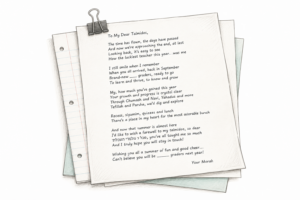
The school year is winding down — and if you’re like most teachers we know, you’re not quite ready to say goodbye to your students. You’ve given these girls more than lessons. You’ve given them your time, your warmth, and a piece of your heart. When a student opens her mailbox in July and finds a letter from her teacher, it tells her something no lesson plan ever could: You’re still on my mind. You matter to me beyond the classroom. That kesher — that connection — is the kind that lasts a lifetime. Out of school, out of context, and still thinking of her. Before the last day of school, take a few minutes and jot down one small thing about each student — a moment that stood out, a quality you admire, something she did that made you smile. Don’t overthink it. That small note, written while she’s
If you had a quiet moment this summer, what would you want to get better at? This one isn’t for everyone. Some of you are
For the Teacher Who Can’t Find the Words The last day of school has a feeling all its own. Backpacks bulge with the year’s worth
The school year is winding down — and if you’re like most teachers we know, you’re not quite ready to say goodbye to your students.

As we continue developing the K’mayim approach, we focus this week on something that happens right in real time—in the classroom, during teaching. Week 4:Where

As we continue the K’mayim Sefira Challenge, we turn to the moments that often matter most—the small, unplanned interactions outside the classroom. Week 4:On A

As we continue the K’mayim Sefira Challenge, we return to a place that quietly shapes everything—our פנימיות. Week 2:Daven for Her The Challenge Choose

End-of-year celebrations in early childhood should feel joyful, simple, and meaningful—for both children and teachers. You don’t need anything overproduced to make it memorable; it’s