

Movement Builds Minds:
3 Ways to incorporate more kinesthetics in your learning
Have you ever noticed how children remember songs with motions better than spoken directions alone? That’s because movement anchors learning. When children act out information, march while counting, or form letters with their bodies, they strengthen learning in several ways at once. They create multiple memory pathways — visual, auditory, and kinesthetic.
The more pathways involved, the stronger the retention.
The best part? You don’t need special equipment or extra time. Movement can easily become part of your everyday classroom routine.
1. Add motions to songs and stories
Whether students are singing along or just listening, involve them by adding motions for them to mimic. When reading a story, invite children to copy your movements, use hand motions for key words, or act out parts of a story as you read.
2. Use cross-body warm-ups before or during circle time
Short movement breaks help young children get their bodies ready to learn. One of the most powerful forms of movement for brain development is bilateral coordination — the ability to use both sides of the body together in a controlled and organized way.
Examples include:
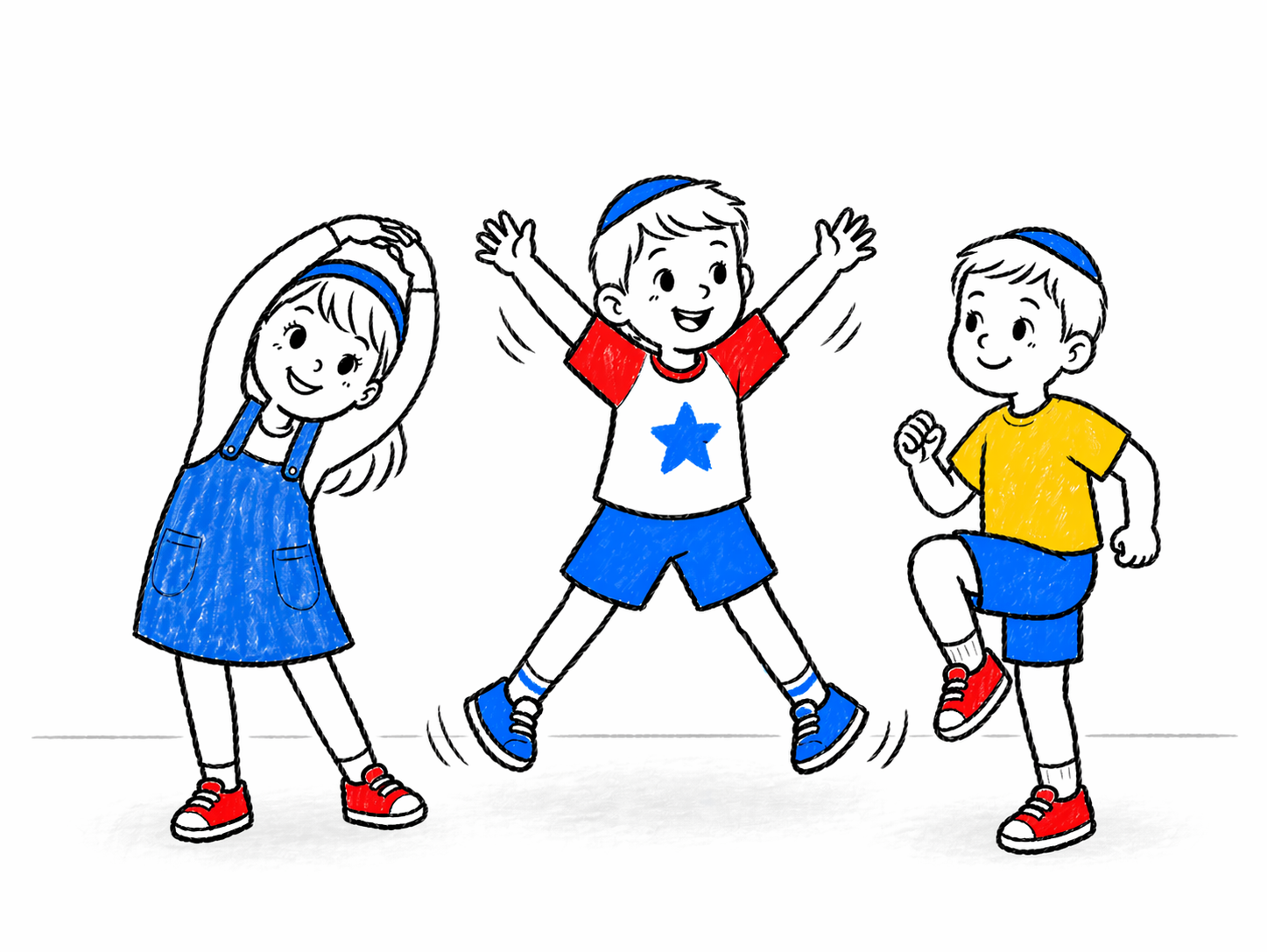
- Cross-crawl
Touch right hand to left knee, then switch - Jumping jacks

Big, simple whole-body movement - Ball toss
Gently toss and catch - Air-Biking
Lay on the back and raise legs to pedal in the air. - Scissors-Walks
Stand with one leg and arm forward and the other back, then jump/switch sides simultaneously.
For example: Right arm forward, left arm back. Right foot forward, left foot back. Jump and switch- right arm back, left arm forward. Right foot back, left foot forward.
3. Include movement- based activities during circle time
Circle time doesn’t have to mean sitting still the entire time. Try ideas like:
- Four Corners
Label the four corners of the room with different visual images; students walk to the corner that corresponds to a card they are holding or something Morah says.
- Ball Toss
Toss a soft ball or beanbag to students; the student who catches it answers a review question, or has a chance to share.
When movement is part of learning, children stay more focused, enjoy the experience more, and remember more of what they learn.