



7 Tips for Teaching Pesach

7 veteran teachers share their top tips for teaching Pesach

MORAH BUSEL
7th Grade, Bais Yaakov D’Rav Meir
Prepare thoughtfully. Know the purpose of each mitzvah and each paragraph of the Haggadah, and internalize its flow so your teaching is clear, deep, and intentional.

MORAH ZIEMBA
6th Grade, Bais Yaakov 18th Ave
Maintain clear focus:
The objective is to illuminate the pshat of the Haggadah while conveying enduring messages of emunah.

MORAH WEISSMANDL
7th Grade, Bais Yaakov D’Rav Meir
Cultivate a calm, structured classroom environment that enables students to absorb the emunah.

MORAH KNOBEL
7th Grade, Torah Academy for Girls
Divrei Torah should reinforce the hashkafic themes of Pesach to maximize time and impact.
Brief daily quizzes—including a question on a Dvar Torah— strengthen accountability.

MORAH GANZWEIG
7th Grade, Bais Yaakov Boro Park
Incorporate color-coding into the pesukim of “Arami Oved Avi.”
The visual cues serve as familiar anchors, equipping students to follow the storyline at the Seder.

MRS. SARA CHAYA FARBSTEIN
TU Educational Consultant
Gather information about each student’s minhagim to bolster pride in her family’s mesorah.
Allocate time to teach about the rest of Pesach, not just the Seder.

MORAH STEFANSKY
6th Grade, YDE
Establish a system of accountability that fosters student ownership of their Haggadah.

MORAH DECKELBAUM
Curriculum Coordinator, Bais Tova
• Create your own lessons directly from the primary sources. Gain an understanding of the flow of the Haggadah so your teaching reflects clarity and coherence.
• Live overview of the flow of the haggadah.
• Develop key vocabulary so students can independently decode and understand the Haggadah.
• Use worksheets as a concluding activity, rather than completing them throughout the lesson.

One Response

  1. This was transformative! I grapple with teaching maggid every year. The students have so much information from previous years, how do I keep it a chiddush, but also basic, and cover ground in limited time, etc. Morah Deckelbaum really clarified all of that for me. I especially liked that the session was short and targeted.

Leave a Reply

Your email address will not be published. Required fields are marked *

MORE TO EXPLORE

Preventing the Summer Slide

Small efforts, big impacts We know how quickly children grow when learning is consistent—and how quickly skills can fade when routines disappear for months. The “Summer Slide” is real. Children can lose foundational academic skills, and even social and emotional progress, over the break. For some, September feels less like a continuation and more like starting all over again. A few intentional moments each week throughout the summer can help reinforce and protect the skills students worked hard to master during the year. That said, summer was never meant to be a third semester. Young children still need rest, play, family time, and freedom—and the goal isn’t to push them toward new skills. It’s simply to preserve what they already know.  The Balance According to one of Torah Umesorah’s leading Intervention Specialists, assigning summer homework three times a week is sufficient for maintaining students’ progress. The assignments don’t need to
Read More »

Let Summer Refill You 

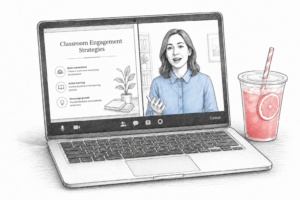
If you had a quiet moment this summer, what would you want to get better at? This one isn’t for everyone. Some of you are busier in July than in January — summer jobs, kids home, camps, family. If that’s you, bookmark this for when things settle.  But if you do find yourself with a quiet mid-morning once the kids are out, or a calm early evening before the night gets going — that might be exactly enough. Torah Umesorah is offering sessions built for exactly those pockets of time. As little as 20 minutes, and you walk away with something real and usable for your classroom. Live   Zoom or phone sessions Scheduled during mid-morning and early evening hours, when things tend to quiet down. On your own time   Recorded sessions Listen whenever works for you — folding laundry, on a walk, or with a cup of coffee.

Read More »

For the Teacher Who Can’t Find the Words

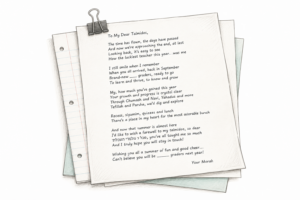
For the Teacher Who Can’t Find the Words  The last day of school has a feeling all its own. Backpacks bulge with the year’s worth of seforim and workbooks. The classroom looks a little bare already. Coat hooks hold one last sweater. And somewhere between the goodbyes, you find yourself wondering where the time went.  And then they’re gone. Just like that, the room that held so much — the noise, the questions, the breakthroughs, the giggles — goes quiet. There’s a particular hollow feeling that settles in when the last talmidah walks out the door, a mix of pride and nostalgia that’s hard to put into words. You want to stop them on their way out. You want to tell them how much they’ve grown, how much you’ve grown, how this year meant something. But you also know — because you know them — that a heartfelt speech from


Read More »

Send Us A Message

WE THINK YOU'LL LIKE THESE

Week 2: Daven for Her

As we continue the K’mayim Sefira Challenge, we return to a place that quietly shapes everything—our פנימיות. Week 2:Daven for Her   The Challenge Choose

Read More »

General Studies

At this time we offer classroom setup materials only for General Studies. You can also browse themed bulletin boards by clicking General Studies in the menu.

Grade

1

Grade

2

Grade

3

Grade

4

Grade

5

Grade

6

Grade

7

Grade

8

Bring it up a level with ChinuchHub workshops:

torah (by Torah Umesorah Teacher Center)

Limudei Kodesh

calculator (by Torah Umesorah Teacher Center)

General Studies

toy blocks (by Torah Umesorah Teacher Center)

Early Childhood

by Torah Umesorah Teacher Center

Interactive Supplies

by Torah Umesorah Teacher Center

Browse By Grade

Best
Sellers