



Kvetches, thoughts and tips on teaching through play season by teachers like you.
Join ‘em
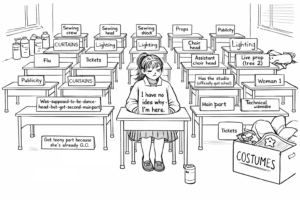
The majority of teachers shared roughly the same game plan: Don’t fight them – show genuine interest and share in their excitement. Hindy acknowledges that teaching during production season is definitely compromised teaching. “It’s not just the missed class time – it’s a serious lack of focus.” Still, she believes that these few weeks mean the world to so many students and create their fondest high school memories. “Make peace with the reality of play season and lean into it,” she advises.



Liba says that when she gives her students time to talk about the play, they feel like she’s “in on it”. She finds that the more she connects with their performance, the better they snap back into real learning in her class post-play season. Of course, she tries to attend either the dress rehearsal or the play. “I find that I gain more than I lose when I show interest and devote time to their play, when I don’t make them feel that their year’s highlight is a nuisance to me.”
Set (very) Realistic Goals
Shifra, a veteran mechaneches who just recently returned to teaching after a ___ hiatus, has what to share from her years of experience. “Set a realistic learning goal to have reached by the end of play season. Be transparent with the girls about it. ‘Throughout play season, we are going to cover chapters/perakim _____. Even if you’ll be out of class, you are still responsible to make up the work.’ And incentivize! ‘If we meet our goal, and we still have time at the end, then we’ll learn something light/I’ll teach you some interesting voice techniques I learned when I headed choir in 11th grade.’”
Capitalize!
Mindy’s candid take: “As a high school teacher, teaching three, four, or five 45-minute periods a week, opportunities for connection need to be expertly spotted and grabbed.” She looks forward to play season as a highlight in this respect. “I get to show them that I’m interested, that I care, and that I relate to their experiences. I share memories of my own tryout traumas and compliment them on whatever practice and prep I get to see. I was given a period to supervise practice, anyway – why should I not use it to look out and find girls who I can literally light up with just a compliment?”
Mimi says it does her good to sit through her students’ performance and be wowed to see girls shining onstage (or backstage) – especially those she never dreamed had such talent. She gets to see her students on an entirely new level. “That’s what play is all about. If we lose sight of that mission, then we have no need for a performance.” Mimi goes so far as to bring a little notepad along with her, jotting down a list of names and details to remember to compliment when she returns to class the next day.
Something as tiny as a safety pin in a sleeve that’s too long or a sentence as short as ‘Sury, you are a fantastic dancer!’ can be what sticks with them for the rest of the year – or even the rest of their lives.